Deep Research & Description
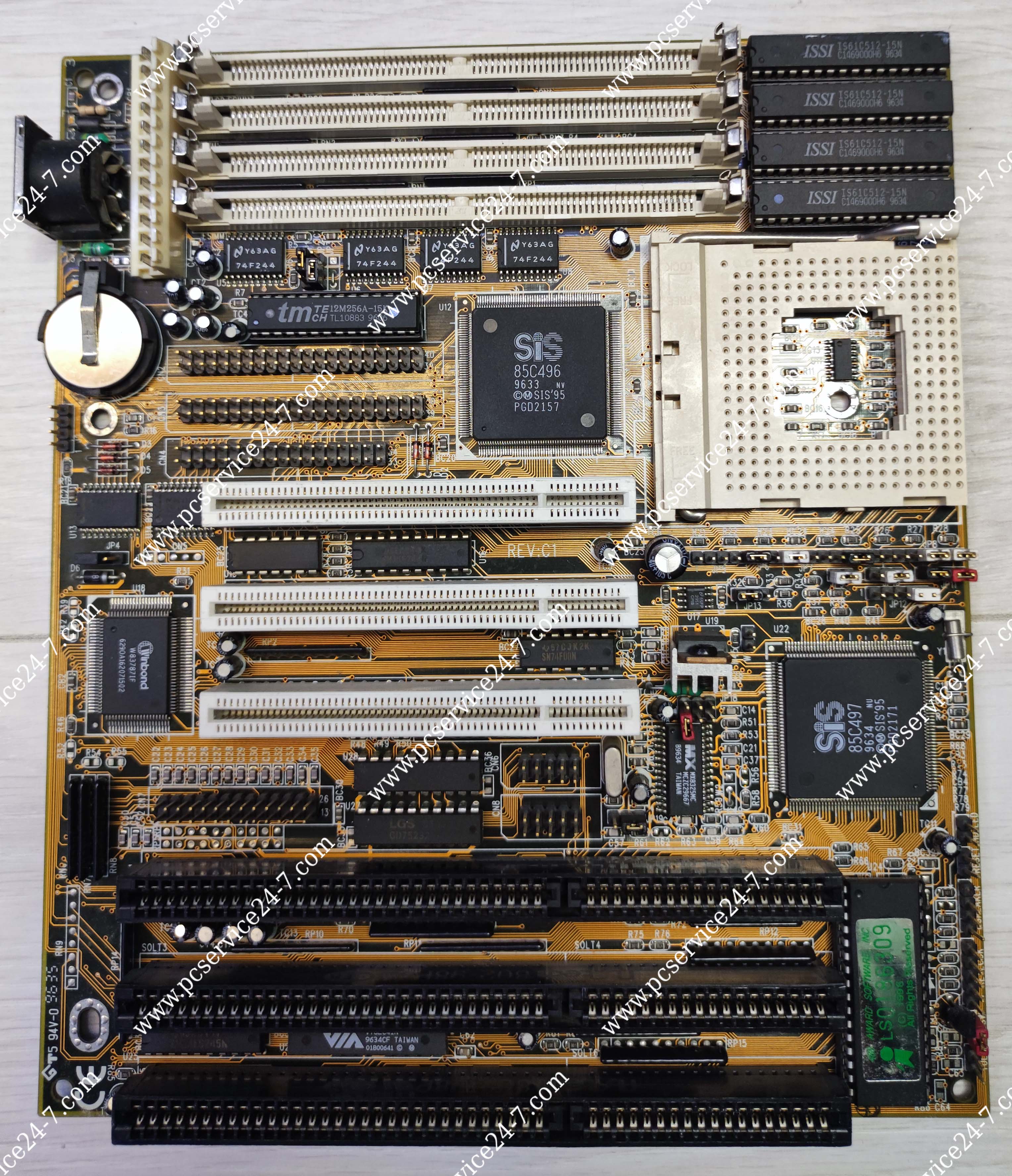
The Lucky Star LS-486E Rev:C1 is a true survivor from the peak of the 486 era (circa 1994-1995). Produced by Lucky Star—a prolific manufacturer for the “white-box” clone market—this board is a classic example of a high-integration Socket 3 platform that bridged the gap between the old 16-bit ISA world and the high-speed VESA Local Bus (VLB).
The LS-486E is built around the SiS 85C496/497 chipset, widely considered one of the best and most compatible chipsets for the late 486 generation. Unlike earlier 486 boards that were plagued by compatibility issues with different CPU voltages, the Rev:C1 was designed to be a “universal” host. It features a robust set of jumpers that allow it to support everything from the original Intel 486DX-33 to the high-performance AMD 4×86 (Am5x86-P75) running at 133MHz.
Technically, the highlight of this board is its VESA Local Bus (VLB) implementation. In the early 90s, the standard ISA bus was too slow for the new wave of “Windows Accelerators” and high-speed IDE controllers. The LS-486E provides three VLB slots (identifiable as the long brown extensions at the end of the ISA slots), allowing the graphics card and hard drive controller to communicate directly with the CPU at the full bus speed (usually 33MHz or 40MHz).
Architecturally, the LS-486E Rev:C1 was a “hybrid” memory board. It was released during the transition from the old 30-pin SIMMs to the newer 72-pin SIMMs. Depending on your specific sub-revision, you likely have a mix of both, or four 72-pin slots, allowing for a massive (for 1994) 64MB or 128MB of RAM. It also features SRAM Cache sockets, which were essential for providing the “burst” performance needed to make Doom or Quake playable.
Era Context
-
The “Turbo” Button Era: This board is from the time when your PC case had a physical button to slow the computer down. Why? Because some older DOS games were tied to CPU clock speed; on a 100MHz 486, they ran so fast they were unplayable!
-
VLB vs. PCI: The LS-486E was one of the last great VLB boards. Shortly after this, Intel’s Pentium processors made the PCI bus the new standard. VLB was faster for 486s, but it was notoriously finicky about signal interference if you used more than two VLB cards.
-
Operating System: The definitive MS-DOS 6.22 and Windows 3.11 (Windows for Workgroups) platform. It can run Windows 95, but it’s at its happiest in the 16-bit era.
-
The “Write-Back” Cache: Revision C1 added better support for “Write-Back” cache mode on newer CPUs. This provided a ~10% performance boost over the older “Write-Through” method, making it a favorite for gamers trying to eke out every frame in Duke Nukem 3D.
This board is a masterpiece of mid-90s “Clone PC” history. It’s the perfect foundation for a high-end 486 build—especially if you have a VLB graphics card like a Cirrus Logic GD5428 or a S3 805 to plug into it.
Component Gallery

Quick Specs
| Feature | Specification |
| CPU Socket | Socket 3 (ZIF) |
| Supported CPUs | Intel 486 SX/DX/DX2/DX4, AMD/Cyrix 486 & 5×86 |
| Chipset | SiS 85C496 (North) / 85C497 (South) |
| Bus Speed | 25 / 33 / 40 / 50 MHz (Jumper selectable) |
| Expansion Slots | 3x VESA Local Bus (VLB), 4x 16-bit ISA |
| Memory | 4x 72-pin SIMM slots (On most Rev:C1 units) |
| L2 Cache | 128KB / 256KB / 512KB (DIP-28 SRAM) |
| BIOS | Award 486 BIOS |
| Form Factor | Baby AT (Fits into “Turbo” desktop cases) |