Deep Research & Description
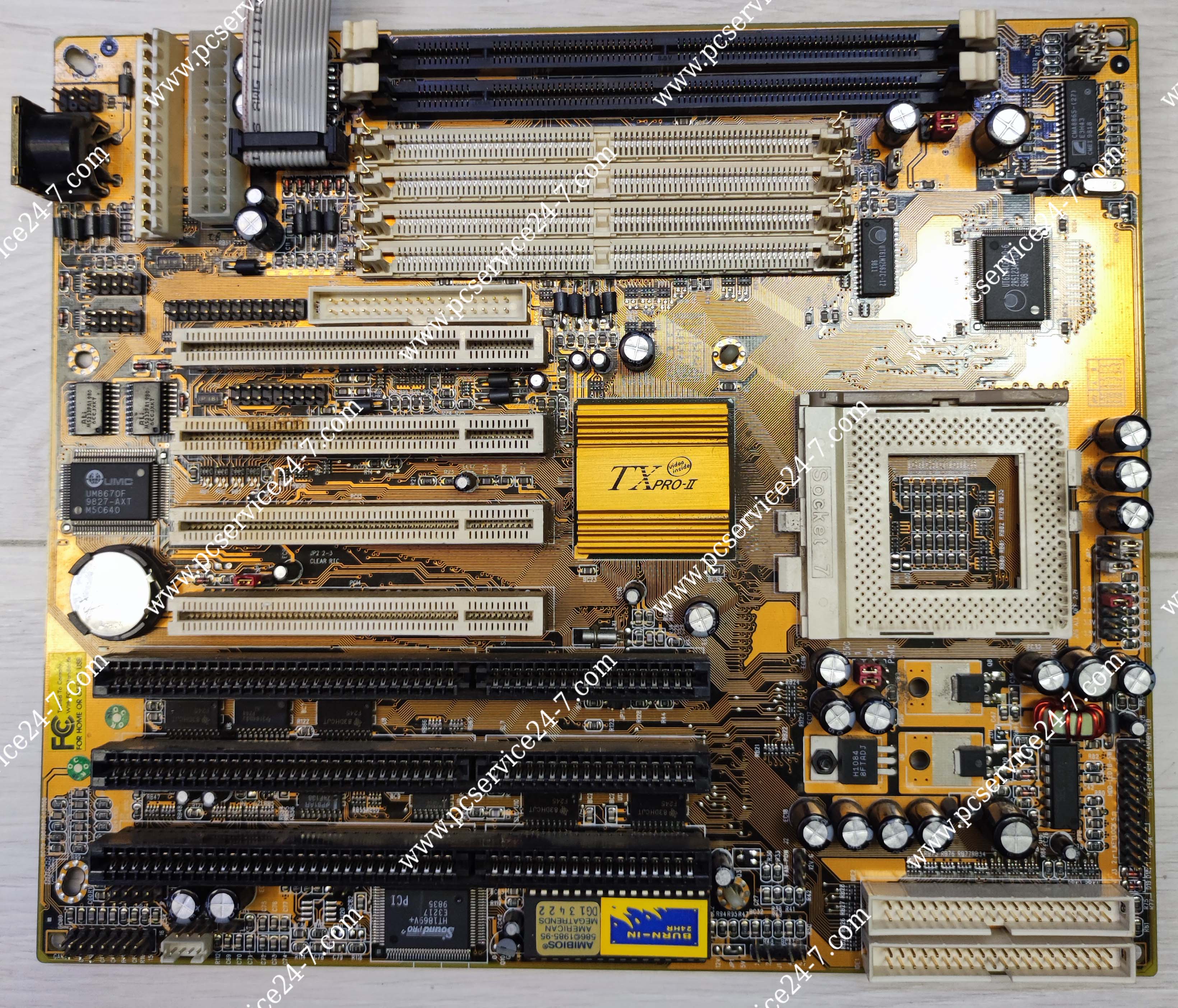
The TX Pro-II is one of the most infamous and fascinating artifacts of the late-90s “clone” market. Usually manufactured by PCChips (though often unbranded or labeled as “Hsing Tech”), it is a masterclass in aggressive budget marketing. In an era where Intel’s 430TX was the gold standard, this board arrived with a name designed to confuse consumers into thinking they were getting an Intel-based “Pro” product, while actually utilizing a highly integrated SiS (Silicon Integrated Systems) chipset.
The TX Pro-II is built around the SiS 5597/5598 chipset. At a time when PC parts were expensive, this board was the ultimate “all-in-one” solution for the budget-conscious user. It integrated features that normally required several separate cards, including the 64-bit 2D/3D graphics controller (shared with system memory) and the SoundPro (usually a C-Media CMI8330) audio controller.
Technically, the board is a Socket 7 platform with a “hybrid” personality. Like many of your other late-90s boards, it utilized the Baby AT form factor but often featured both AT and ATX power connectors. It was a bridge for users moving from the 486 era into the Pentium MMX or AMD K6 world.
However, the TX Pro-II’s most enduring legacy is the “Fake Cache” Controversy. PCChips was notorious for soldering plastic blocks labeled “Write Back Cache” onto the motherboard that contained no actual silicon. They would then modify the BIOS to report “512KB Cache Active” during the boot screen. While some high-end revisions did have real SRAM, a huge percentage of these boards were essentially running without L2 cache, significantly hampering performance while deceiving the user.
Era Context
-
The “All-In-One” Pioneer: Despite its questionable marketing, the TX Pro-II helped pioneer the “Integrated Motherboard” concept. Before this, you had to buy a video card and a sound card. This board made the PC accessible to millions who couldn’t afford a high-end system.
-
The BIOS “Magic”: The BIOS on these boards was heavily customized. It would often show a full-screen logo or a colorful “PC-100” or “TX Pro” graphic to hide the fact that the underlying hardware was quite modest.
-
Operating System: The definitive Windows 95 and Windows 98 budget platform. Because of the shared video memory, it often felt “sluggish” in Windows compared to systems with dedicated 2MB or 4MB video cards.
-
The Technical Challenge: These boards are a favorite for modern-day “retro-tech” detectives. Testing the cache speed in DOS using tools like
CACHECHKto see if the L2 cache is real or fake is a classic hobbyist pastime.
Component Gallery
Quick Specs
| Feature | Specification |
| Manufacturer | PCChips (Hsing Tech) |
| Main Chipset | SiS 5597 / 5598 (Relabeled as TX Pro-II) |
| CPU Socket | Socket 7 |
| Supported CPUs | Intel Pentium / MMX, AMD K5 / K6, Cyrix 6×86 / MII |
| Bus Speed | 60 / 66 / 75 MHz |
| Memory | 2x 168-pin SDRAM DIMMs + 2x 72-pin SIMMs |
| Integrated Video | SiS 64-bit (Uses Shared System Memory) |
| Integrated Audio | SoundPro (C-Media CMI8330) |
| Expansion | 1x Shared PCI/ISA, 2x PCI, 1x ISA (Layout varies) |
| Form Factor | Baby AT |