Deep Research & Description
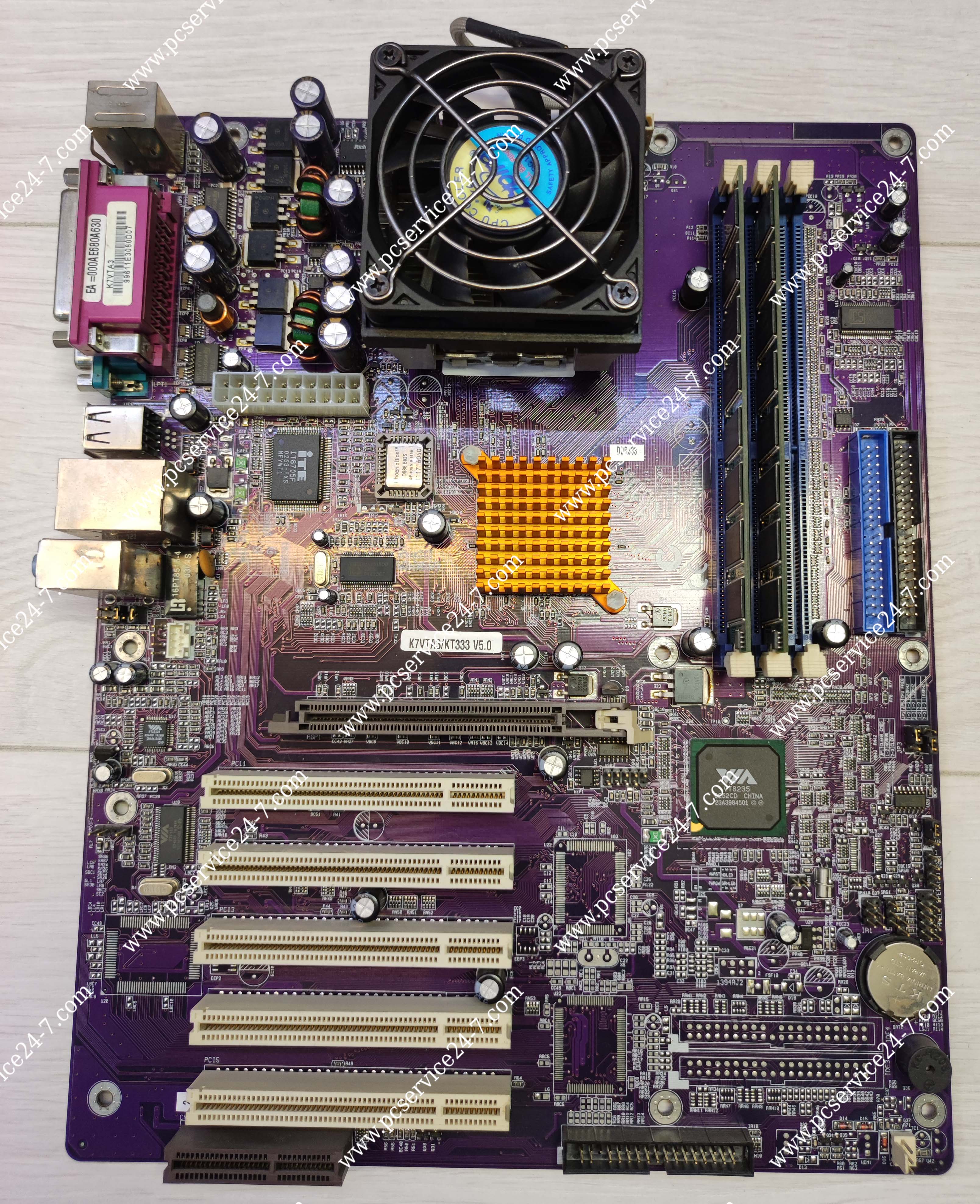
The V5.0 revision is technically superior to the earlier V1.0 and V2.0 boards. While it retains the VIA Apollo KT333 (VT8367) North Bridge, it upgraded the engine room to the VIA VT8235 South Bridge. This was a major jump; it brought native USB 2.0 (supporting up to 6 ports) and Ultra DMA 133 support directly into the silicon, eliminating the need for the sluggish third-party controller chips found on older revisions.
Architecturally, the V5.0 is designed for the AMD Athlon XP “Palomino” and “Thoroughbred” cores. By supporting DDR333 (PC2700) memory across three DIMM slots, it provided the high-bandwidth pipeline needed for late-era DirectX 8.1 gaming. However, because it was released before the AMD Sempron launch, this specific revision has a hardware limitation: it does not officially support Sempron CPUs (that required the V6.0 PCB or higher). It remains a “pure” Athlon and Duron thoroughbred.
In the museum of hardware, the V5.0 is often recognized by its slightly more organized layout. ECS moved the IDE connectors to be more accessible and refined the power delivery to handle the increasingly power-hungry Athlon XP chips. It’s the definitive “Budget Enthusiast” board of 2002—stable, surprisingly fast for its price, and a staple of the “purple PCB” era.
Era Context
-
The Sempron “Lockout”: This board is a time capsule of the pre-Sempron era. If you try to drop a Sempron 2400+ into a V5.0, it will likely fail to boot or misidentify the chip. It’s a “period-correct” platform that demands an Athlon XP 2100+ or 2400+ to truly shine.
-
USB 2.0 Transition: Because this revision used the VT8235 chip, it was one of the first budget boards that didn’t require a separate PCI card to get decent speeds for early MP3 players and digital cameras.
-
The “333” Advantage: At the time, DDR333 was the performance standard. Pairing this board with a GeForce4 Ti 4200 created what many considered the “Ultimate 2002 Mid-Range Build.”
-
Reliability: The V5.0 was known for being far more stable than the early V1.0 boards, which often suffered from BIOS quirks. By this revision, ECS had matured the platform into a rock-solid workhorse.
Component Gallery
Quick Specs
| Feature | Specification |
| Model | K7VTA3 V5.0 (K7VTAS) |
| CPU Socket | Socket A (462) |
| Supported CPUs | AMD Athlon XP / Athlon / Duron |
| Chipset | VIA KT333 (North) + VT8235 (South) |
| FSB Support | 200 / 266 / 333 MHz |
| Memory | 3x DDR DIMM Slots (Max 3GB DDR333) |
| Expansion | 1x AGP 4X, 5x PCI Slots |
| Storage | 2x IDE Ultra DMA 133/100/66 |
| USB | 6x USB 2.0 (Native in South Bridge) |
| Audio | VIA VT1612A AC’97 (2-Channel) |
| Form Factor | ATX (305mm x 244mm) |